Cisco AI Security
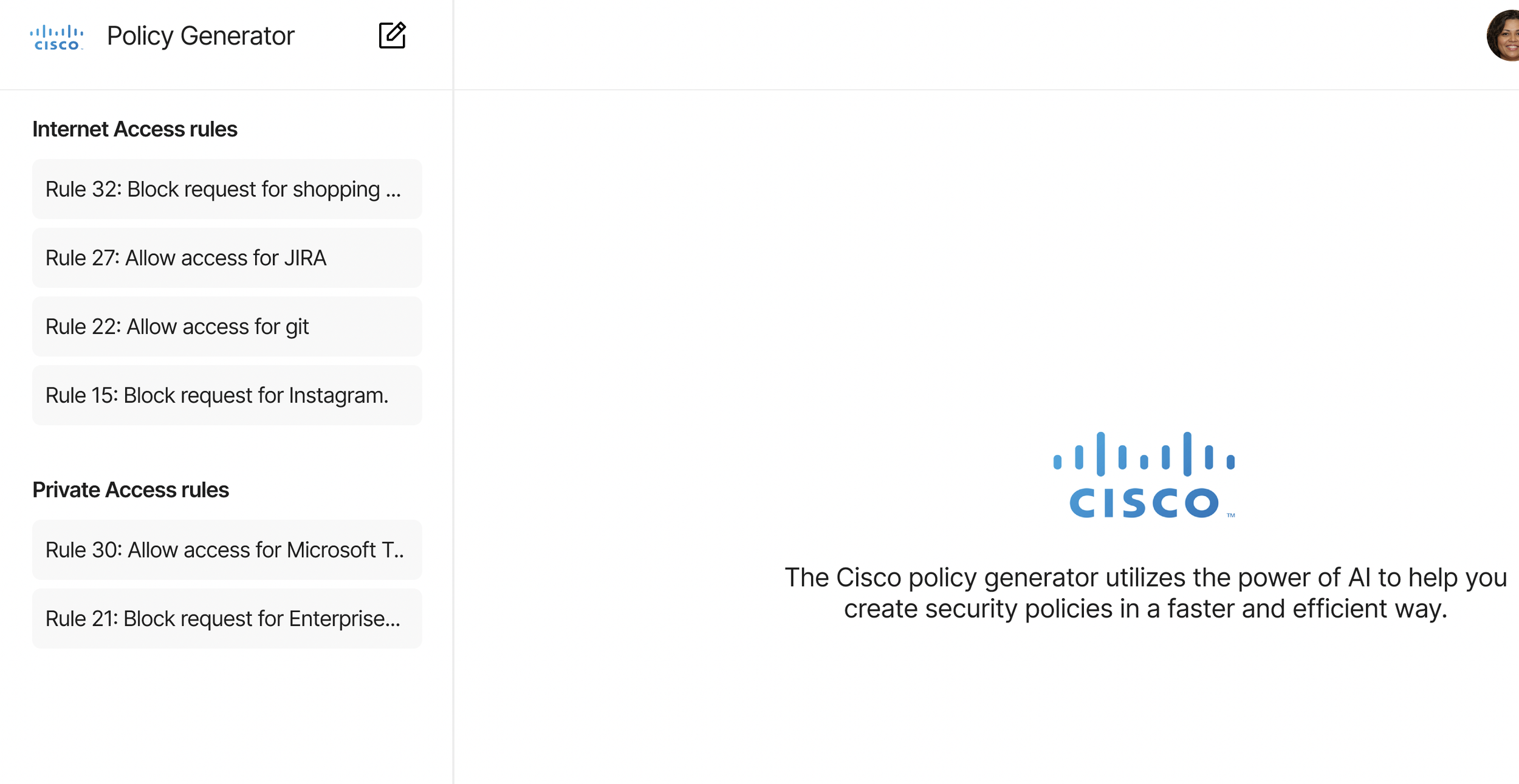
Cisco AI Assistant: Designing for Trust in Enterprise AI
Role: UX Researcher & Strategy Lead
Team: 4-person Design Team + Cisco Security Engineers
Overview
This project focused on improving trust in an enterprise AI assistant used within Cisco’s security environment. The challenge was designing an experience that allowed users to get useful AI responses while still respecting strict data governance policies.
In high-stakes corporate environments, the success of AI hinges entirely on organizational trust. When stakeholders lack visibility into how their data is managed, adoption stalls. This project aimed to bridge that transparency gap, designing a framework that balances seamless usability with rigorous data control.
Understanding the Problem
Stakeholder interviews and system audits revealed a low baseline of trust regarding AI data residency. Users lacked a clear mental model of how their information was stored, leading to hesitation and reduced system adoption.
At the same time, security administrators found it difficult to configure policies in a way that was both precise and easy to manage.
This created an opportunity to design a system that made AI access levels more transparent while simplifying administrative control.
My Contribution
I led the research and strategy efforts. My work included:
Auditing enterprise AI governance models
Conducting competitive analysis
Mapping user roles and data access layers
Working with engineers to understand technical constraints
I focused on making sure the UX aligned with how the system actually handled data behind the scenes.
The Solution
We introduced a layered access control system that:
Secured AI responses by automatically scoping data based on specific user permissions
Ensured data safety by including visual indicators that explain exactly why certain sensitive information was restricted
Simplified the administrative oversight for managing and enforcing these strict data governance policies
The goal was not just compliance, but clarity. Users needed to understand how the system was safely handling their data.
Feedback & Iteration (Employee Validation)
During the final presentation, enterprise users and internal stakeholders tested the prototype:
Clarity: Employees reported that they could understand how AI data can be restricted, which increased their trust in the system.
Efficiency: Administrators commented that the interface felt more organized and intuitive for managing access policies.
Transparency: Stakeholders appreciated the visual indicators showing access restrictions, describing the system as “clearer and more predictable.”
Minor insights: A few participants suggested small tweaks to icon labeling for first-time administrators, which were noted for future refinement.
This session validated the design decisions and demonstrated that the interface effectively communicated complex AI governance rules to end users.
Impact
Usability feedback showed a 20% increase in perceived reliability compared to earlier versions. Users reported feeling more confident in how the AI handled sensitive data, and engineering stakeholders confirmed the design was technically feasible.
Reflection
This project taught me how different enterprise UX is from consumer-focused design. Many decisions were shaped by technical and security constraints, not just user preferences.
One of my biggest takeaways was that transparency builds trust. Users were more comfortable with restricted results when they understood the reason behind them. Designing for clarity, rather than just access, became a key principle I carried into later projects.
Click the PDF below for further details about our project:
Cisco AI Security Team Presentation
Click here to access the prototype: