Sonic Alert: Reducing Emergency Response Time in Schools
Role: UX Designer & Research Contributor
Team: Student design team
Competition: CHI Student Design Competition
Overview
Sonic Alert was developed for the CHI Student Design Competition and focused on improving emergency communication in schools.
Instead of redesigning hardware or alarm systems, we focused on how people interpret alerts during high-stress situations.
Research
We studied existing emergency workflows to understand people’s experiences in crisis situations. One consistent insight emerged: the first few seconds of an emergency are often lost to confusion.
People hesitate because they aren’t sure what the alert means or what action to take.
My Process
Survivor-Centric Research: When law enforcement and school administration access was restricted, I pivoted to networking with a survivor of the 2021 University of Chicago shooting. Her insights into the lack of early detection signs shifted our problem statement from "prevention" to "response-time mitigation."
Rapid Iteration: I sketched low-fidelity prototypes designed for high-stress usability, ensuring the interface could be understood instantly during an emergency.
Design Direction
We proposed a system that:
Used distinct audio patterns for different emergency types
Reduced ambiguity in alerts
Reinforced instructions through multiple sensory channels
The goal was immediate comprehension, even under stress.
The Solution
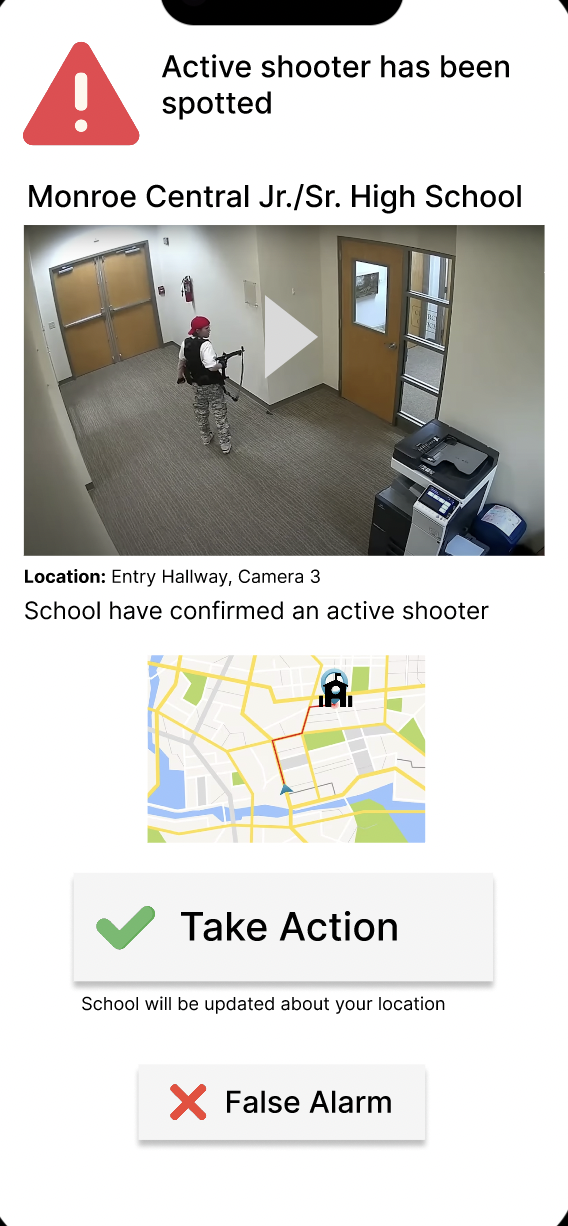
Acoustic Edge Detection: Developed an integrated system of sound detectors and cameras that identify gunshot audio signatures to immediately alert authorities.
Crisis Dashboard: A high-fidelity mobile application that provides staff with immediate threat data and automated communication channels.
Feedback and Stakeholder Review
Critical Design Critique: During our final presentation, faculty and peers highlighted the need for real-time shooter location updates and "Safe Map" wayfinding for students.
Operational Edge Cases: A key insight from the review was the "unattended device" risk—how to alert staff who may not have immediate access to their mobile devices during a crisis.
Future Scope and Strategic Roadmap
Adaptive Evacuation: Implementing dynamic route guidance and intelligent signage that updates based on the shooter's real-time location.
Automated Lockdown: Integrating a system that manages building access points instantly upon gunshot detection.
AI Refinement: Leveraging machine learning to improve detection accuracy and reduce false positives, continuously learning from new acoustic data.
Reflection
Working on a safety-focused project required a different mindset. Instead of optimizing for convenience or speed, we had to think about clarity, reliability, and emotional impact.
It pushed me to consider the ethical side of design and how small usability decisions can have serious consequences in real-world situations.
Click here for the full project details and presentation: