UX Insurance: Minimalist Interface Architecture
Role: UI/UX Designer
Overview
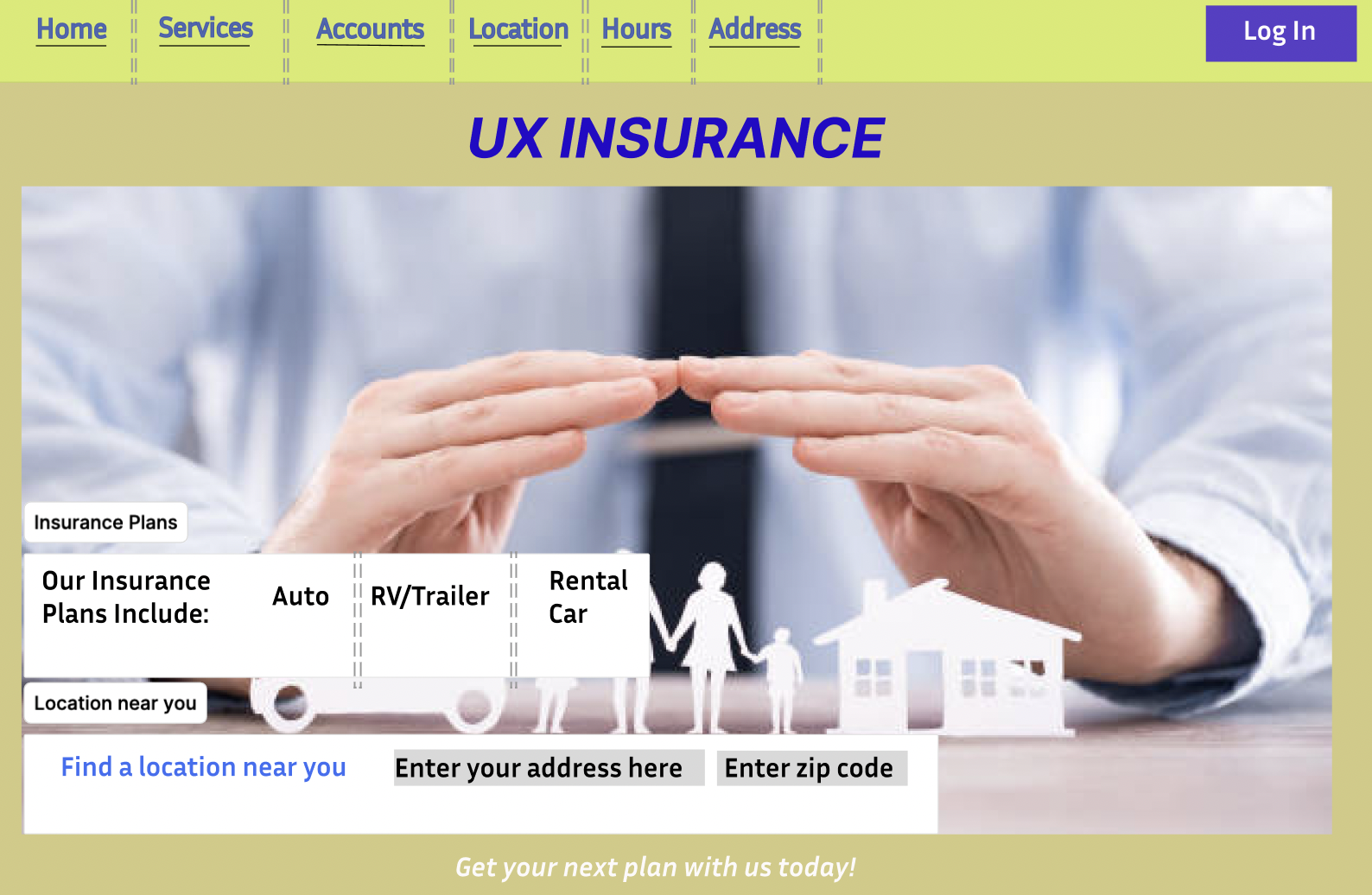
I was tasked with designing a comprehensive insurance homepage using a strictly limited set of interface elements. The goal was to integrate complex requirements—multi-level navigation for services, account management, and geolocation features—into a frictionless, minimalist experience without compromising clarity or usability.
Understanding the Problem
Insurance portals are often cluttered with secondary features and dense information. Users can feel overwhelmed, especially when trying to access core tasks like managing coverage, submitting claims, or checking account information. The challenge was to simplify the interface while keeping all critical functionality accessible.
My Contribution
I focused on simplifying hierarchy and reducing cognitive load:
Prioritization Strategy: Adopted a mobile-first mindset even for desktop layouts. Identified the three primary user intents—coverage discovery, account management, and claims contact—then removed secondary distractions.
Navigation Hierarchy: Consolidated links (Home, Services, Insurance, Accounts) into a high-visibility persistent header so users never felt lost.
Streamlined Flow: Positioned login and contact functionality in the primary conversion zone to reduce clicks for essential tasks.
Cognitive Load Reduction: Followed a “Obvious over Clever” principle, ensuring simplicity functioned as both usability and visual clarity.
Feedback and Iteration
Usability Testing: Validated the prototype with peers and faculty. Feedback highlighted the clarity and realism of the simplified structure.
System State Awareness: Adjusted transitions and visual cues to indicate user location within the interface, ensuring minimalism didn’t create ambiguity.
Iteration: Refined screen flows based on user insights to improve navigation predictability and task completion speed.
Outcome
Usability Success: Prototype was praised for intuitive flow and minimal cognitive load.
Design Recognition: Faculty and peers specifically highlighted the way the simplified architecture addressed complex functional requirements without overwhelming users.
Functional Minimalism: Achieved a balance between clean visuals and robust functionality, supporting efficient task completion for insurance users.
Reflection
This project reinforced that minimalism in UX is functional, not just aesthetic. Limiting elements forced me to prioritize what truly matters for users, which is critical in high-stakes domains like insurance.
I also learned the importance of system state cues and clear hierarchy: even a clean interface can confuse users if they don’t understand where they are or what actions are available. This project strengthened my ability to design interfaces that are both simple and fully functional.